Turkey Teeth
Turkey Teeth: Why Young Brits Are Flying to Istanbul for Veneers


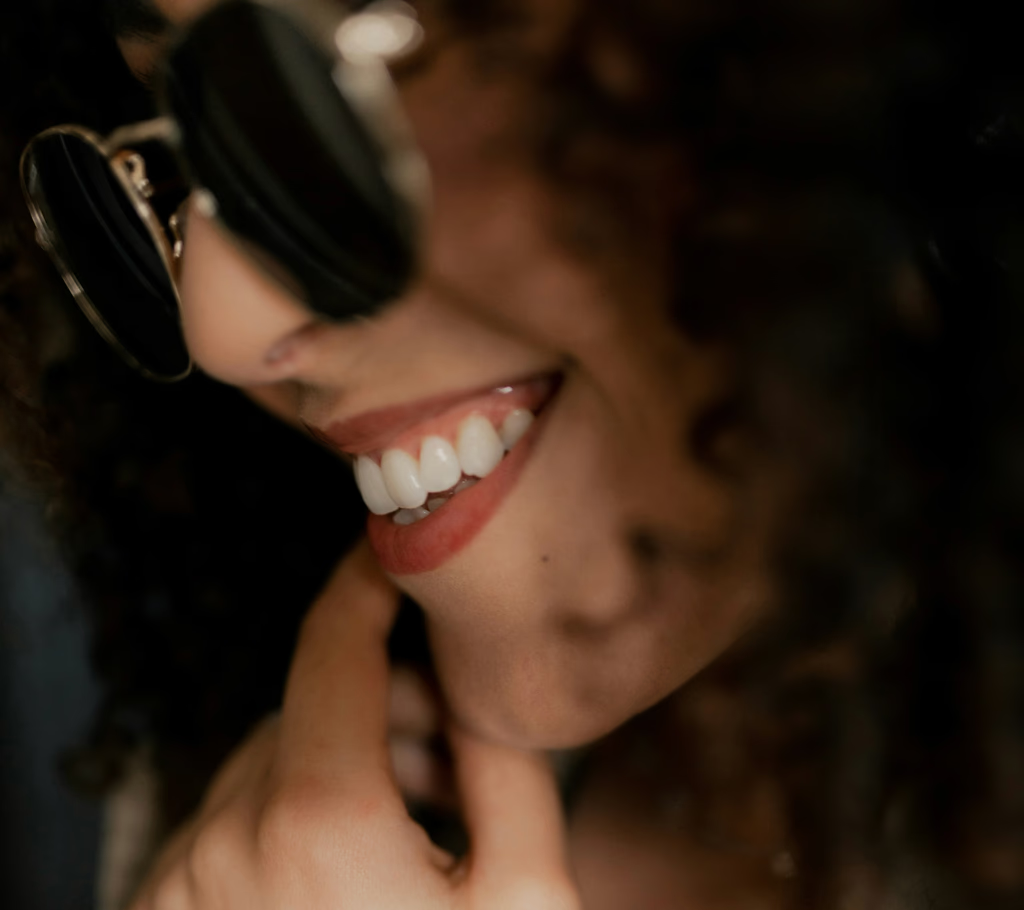
The first thing you notice about Turkey teeth isn't the blindingly white color or the uncanny uniformity. It's how young the patients are. Twenty-somethings who can't afford a house deposit are spending £5,000 on dental work in Istanbul, documenting every step for TikTok, and coming home with smiles that look like bathroom tiles.
This isn't the traditional dental tourism story of retirees seeking affordable implants. Turkey teeth represents something entirely different - a generation choosing dramatic cosmetic transformation over financial security, enabled by social media, payment plans, and Turkish clinics that understand Instagram better than most UK marketing agencies.
The term itself started as mockery but evolved into something more complex. "Turkey teeth" now encompasses everything from genuinely transformative dental work to cosmetic disasters that require years of corrective treatment. The reality, as 250,000 annual dental tourists to Turkey are discovering, sits somewhere between the Instagram posts and the horror stories.
The Economics of a Generation's Smile
Turkish clinics offer full mouth veneers - typically 20 teeth - for £3,000-5,000 including flights and hotels. The same treatment in the UK costs £10,000-20,000 at minimum, with high-end cosmetic dentists charging up to £30,000. For someone earning the UK median salary of £35,000, that's either two months' gross pay or an entire year's earnings.
But the economics go deeper than simple price comparison. These are predominantly people in their twenties and early thirties who came of age during austerity, graduated into a pandemic, and face house prices that have decoupled entirely from wages. The average UK house deposit is £62,000. The average Turkey teeth package is £4,000. One of these seems achievable.
Payment plans have transformed the accessibility equation. Clinics partner with finance companies offering 12-24 month payment terms at 0% interest. Suddenly that £4,000 treatment becomes £167 per month - less than many people spend on coffee and streaming subscriptions. UK cosmetic dentists require credit checks, proof of income, and often substantial deposits. Turkish clinics take a passport photo and a £500 deposit via bank transfer.
The influencer economy adds another dimension. Young people with Turkey teeth can monetize their transformation through social media, with before-and-after content generating thousands of views. Some clinics offer referral programs paying £200-500 per patient. A successful transformation post that sends five friends to Istanbul covers a significant portion of the original treatment cost.
What Turkey Teeth Actually Are
The confusion around Turkey teeth starts with terminology. Most people getting Turkey teeth aren't getting veneers - they're getting crowns, and there's a massive difference that nobody explains until it's too late.
Veneers are thin porcelain shells bonded to the front of teeth, requiring removal of about 0.5mm of enamel. They preserve most of the natural tooth structure and can be replaced relatively easily. Traditional veneers last 10-15 years and cost £500-1,000 per tooth in the UK.
What Turkish clinics often provide are full crowns marketed as veneers. This requires grinding teeth down to pegs - removing 60-70% of the natural tooth structure. Once you've had this aggressive preparation, you're committed to crowns forever. The natural tooth underneath continues to age and potentially decay. When crowns fail after 10-15 years, there might not be enough tooth structure left for replacements.
The aesthetic Turkish clinics deliver is deliberately extreme. Hollywood white (several shades beyond natural), perfectly uniform shape, and a size that Americans call "chiclet teeth" - like the square white chewing gum. This look photographs beautifully on Instagram but can appear uncanny in person. UK cosmetic dentists typically aim for natural enhancement. Turkish clinics optimize for social media impact.
The speed is part of the appeal and the problem. UK cosmetic dentistry involves multiple consultations, temporary veneers, adjustments, and a gradual process that can take 3-6 months. Turkish clinics complete everything in 5-7 days. Preparation on Monday, temporaries on Tuesday, finals fitted by Friday. You fly home with a completely new smile and a mouth full of traumatized tissue that needs weeks to heal.
The Clinical Reality
Turkish dentists are generally well-trained. Istanbul alone has nine dental schools, with Hacettepe University consistently ranking among Europe's best. The dentists performing these procedures aren't unqualified - they're operating in a different economic and regulatory environment that incentivizes volume over conservation.
A UK cosmetic dentist might see two veneer patients per week at £15,000 each. A Turkish dentist sees 10-15 patients daily at £3,000 each. The UK dentist can afford to spend hours on shade matching and micro-adjustments. The Turkish dentist needs to move efficiently through their patient list. Both are rational responses to their market conditions.
The technical quality is usually competent. Turkish clinics use the same materials as UK practices - Emax crowns, zirconia cores, quality adhesives. The labs working with major clinics produce thousands of crowns monthly and have the process refined to an industrial standard. The crowns fit, they function, they look uniform. What's missing is customization and conservative treatment planning.
Communication barriers compound clinical challenges. Consultations happen through translators or in broken English. Consent forms are in Turkish with English summaries that gloss over risks. Patients don't fully understand what's being removed until they see their ground-down teeth in the mirror - a moment of horror that appears in countless Turkey teeth videos.
The lack of follow-up care becomes critical when problems emerge. UK cosmetic dentists see patients multiple times post-treatment, adjusting bite, addressing sensitivity, and ensuring proper healing. Turkish clinics provide WhatsApp support and antibiotics. When infections develop or crowns fail, patients discover that UK emergency dentists often refuse to touch foreign dental work due to liability concerns. Some UK practices take that work on directly, though, starting with an assessment and fresh X-rays to see what's going on beneath the crowns before anyone commits to a price.
The Social Media Machine
Turkey teeth exist because Instagram exists. The phenomenon represents the complete merger of cosmetic enhancement and social media performance, where the documentation of transformation becomes as important as the transformation itself.
Clinics have adapted their entire operation to social media rhythms. They maintain in-house photography studios with ring lights and iPhone mounts. Staff are trained to capture specific moments - the reveal, the emotional reaction, the before-and-after comparison. Patients receive professional photos of their new smile before they've even left the chair.
The content formula is standardized: nervous airport selfie, clinic tour showcasing luxury facilities, preparation process (often the most viral moment showing teeth being ground down), reveal reaction, and triumphant homecoming. This narrative arc generates predictable engagement patterns that clinics track and optimize.
Love Island changed everything. When contestants started returning from the show with identical brilliant white smiles and openly discussing their Turkish dental work, it normalized the procedure for an entire generation. These weren't desperate people seeking basic dental care - they were attractive young people choosing extreme cosmetic enhancement.
TikTok accelerated adoption through algorithmic amplification. Turkey teeth videos regularly achieve millions of views because they combine multiple high-engagement elements: dramatic transformation, medical procedure footage, travel content, and often controversy in the comments. The algorithm doesn't distinguish between positive and negative engagement - horror stories get the same amplification as success stories.
When Turkey Teeth Go Wrong
The General Dental Council received 437 complaints about foreign dental work in 2023, but this represents a fraction of actual problems. Most patients don't file formal complaints about Turkish dental work - they post TikToks that get millions of views instead.
The immediate complications follow predictable patterns. Severe sensitivity affects nearly everyone because extensive tooth preparation exposes dentinal tubules. What Turkish clinics describe as "normal sensitivity" can mean being unable to breathe through your mouth without pain. Infections occur in approximately 8-12% of cases, often because patients can't maintain proper oral hygiene while healing.
Aesthetic failures become apparent once swelling subsides and patients see their new teeth in natural lighting. The Hollywood white that looked perfect in Istanbul appears blue-gray under UK winter light. The uniform shape that photographed beautifully makes eating difficult because all teeth are the same length. The size that seemed proportional in the clinic mirror looks enormous once facial swelling reduces.
Long-term problems emerge gradually. Crowns that seemed secure develop black lines at the gum margin as gums recede. Bite problems cause jaw pain and headaches. Root canals become necessary as traumatized teeth die. Each problem requires expensive UK treatment - a failed Turkish crown might cost £1,000 to fix properly at UK private dental prices. Pinning down which of these problems is actually present, and what it takes to put right, starts with a £20 assessment and X-rays, so the cost is quoted before anything gets touched.
The psychological impact gets less attention but might be more significant. Young people who transformed their smiles for social media discover that perfect teeth don't solve deeper insecurities. Some develop obsessive behaviors around protecting their investment - avoiding certain foods, constant checking for damage, anxiety about future failures. The financial burden of maintaining Turkey teeth over decades wasn't part of the original calculation.
The UK Dental Response
UK dentists find themselves in an impossible position. They're watching patients choose irreversible aggressive treatment abroad while being unable to offer competitive alternatives. A UK dentist suggesting conservative treatment at £15,000 loses to a Turkish clinic offering dramatic transformation at £4,000.
Many practices now refuse to treat Turkey teeth entirely. The liability is too complex - if they attempt repair and something goes wrong, are they responsible for the original poor treatment or just their intervention? Without original treatment records, X-rays, or material specifications, UK dentists work blind. That is exactly what a fresh set of X-rays is for, though: a new assessment reads the roots and bone as they are now, whatever paperwork did or didn't come home from abroad. Some practices have started charging consultation fees just to examine Turkey teeth, knowing most patients won't proceed with UK treatment costs.
The emergency dental system sees the worst outcomes. Patients arrive with acute infections, failed crowns, or exposed nerves requiring immediate intervention. Emergency dentists can address immediate pain but can't provide comprehensive restoration. Patients end up cycling through emergency appointments without ever receiving definitive treatment.
Some UK cosmetic dentists have adapted by offering "Turkey teeth correction" packages. These start at £15,000-20,000 and involve removing failed crowns, treating underlying damage, and creating new restorations. The market for fixing Turkey teeth might eventually exceed the original dental tourism market.
The Generational Divide
Turkey teeth represent a fundamental generational split in how cosmetic enhancement is perceived. Older generations see them as vanity gone wrong - young people destroying healthy teeth for Instagram likes. Younger generations see them as accessible self-improvement - taking control of their appearance when they can't control housing costs, job security, or climate change.
The critics aren't wrong about the clinical concerns. Grinding down healthy teeth for cosmetic crowns violates fundamental principles of conservative dentistry. But the critics also own homes that cost them three times their annual salary, while young people face houses costing ten times theirs. When traditional markers of success become impossible, cosmetic transformation offers an achievable alternative.
Social media collapsed the distinction between necessity and desire. A generation that documents everything naturally documents their dental transformation. The performative aspect isn't separate from the treatment - it's integral to it. The value isn't just in having perfect teeth but in having achieved perfect teeth, documented the journey, and accumulated the social capital that comes with transformation content.
The Turkey teeth phenomenon will likely end not through regulation or horror stories but through aesthetic evolution. The Instagram algorithm already favors new trends over established patterns. The uniformly white, perfectly straight smile is becoming as dated as the Valencia filter. Natural enhancement and subtle improvement are gaining traction. Turkish clinics will adapt, offering more conservative treatments, and the cycle will continue with different procedures and new destinations.
Until then, thousands of young Brits will continue boarding flights to Istanbul, phones charged and ring lights packed, ready to transform their smiles and their social media presence in one dramatically documented week. The teeth they return with might not last a lifetime, but the content they create will live forever in the digital record of a generation that chose transformation over tradition, impact over investment, and immediate gratification over long-term planning.
Ready for Your Dream Smile?
Composite bonding from £199, veneers from £695. 0% finance available on treatments over £500.
Or see all our cosmetic treatments, with prices →