CBCT-planned, every time.
Every implant case is planned on a 3D cone-beam CT scan. We know exactly where your nerves and sinuses sit, how much bone you have, and where the implant needs to go before we ever pick up a drill.
Dental Implants · Three parts, one tooth
The closest thing in modern dentistry to a natural tooth. A titanium root fused into the jawbone by your own biology, topped with a custom crown that looks, feels, and behaves like the tooth you’ve been missing — for decades, if you look after it.
Dentistry has spent fifty years trying to come up with something better than a dental implant. It hasn’t yet.
Chapter One · What it actually is
The implant itself is a small titanium screw, about the size of a Tic Tac, placed carefully into the jawbone where the root of your missing tooth used to be. The bone grows around it over a few months — a process called osseointegration — locking it into place as firmly as if you’d grown it yourself.
Sitting on top of the implant is the abutment, a small connecting piece that emerges above the gum line. And onto the abutment, we cement or screw the final crown — a custom-made, tooth-coloured cap that matches the shape and shade of your surrounding teeth.
From the outside, no-one can tell. From the inside, it functions as a tooth. You brush it, you floss it, you chew with it, you forget about it.
Chapter Two · When it’s right
Not every missing tooth needs one. But when the alternative is a bridge that damages healthy neighbours, or a denture that never quite sits right, an implant is almost always the long-term answer.
Whether it came out in a fall, after a failed root canal, or was lost to decay decades ago — a single implant restores the gap without touching the teeth either side. No bridge needed, no healthy enamel drilled away.
Two or three adjacent teeth can often be replaced with just two implants supporting a short bridge. More cost-effective than an implant per tooth, and stronger than a conventional bridge that relies on the neighbours.
All-on-4 uses four strategically placed implants to support a full set of upper or lower teeth. Life-changing for patients who’ve been wearing dentures and who’d rather not. Fixed in place, feels real, eats like real teeth.
Implant-retained dentures clip onto two or four implants, giving you the security of fixed teeth without the full cost of a fixed bridge. A huge step up from a loose plate that clicks when you laugh.
When existing restorative work has run its course, an implant is often the kindest long-term replacement. We extract what’s left, place the implant, and restore the tooth properly — sometimes in a single surgical visit.
Implants are the quiet success story of modern dentistry. Patients come in for one, and a year later they’re back asking if we can do the other side.
— Dr. Zain Chishty, Clinical Director & Implant Dentist
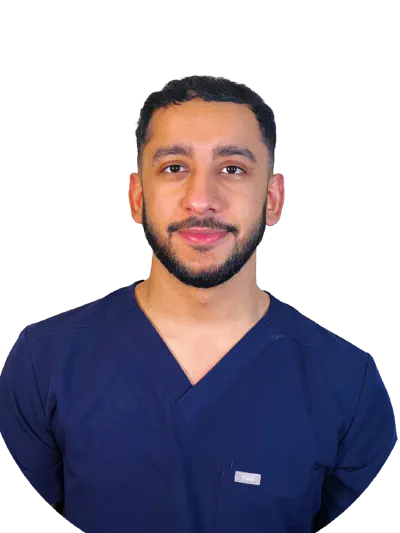
Your implant surgeon
Clinical Director
He plans every implant case on its own CBCT scan, places the implant himself, and fits the final crown: the same pair of hands from your first consultation to your final review. He leads the surgical side of the practice and signs off every implant treatment plan that leaves it.
Chapter Three · Why have it done here
Implant surgery is technical work. Tiny differences in planning, placement, and materials decide whether an implant lasts five years or thirty. These are the six that we refuse to compromise on.
Every implant case is planned on a 3D cone-beam CT scan. We know exactly where your nerves and sinuses sit, how much bone you have, and where the implant needs to go before we ever pick up a drill.
A custom-printed surgical guide sits over your teeth during placement, ensuring the implant goes exactly where it was planned — to within fractions of a millimetre. More predictable, faster healing, better-looking final crowns.
If you’ve lost bone where a tooth’s been missing for years, we can rebuild it. Socket preservation, block grafts, sinus lifts — all handled at our clinic, not referred out to a specialist six months down the line.
For anxious patients or longer cases, IV sedation is available with a dedicated sedation nurse. You’re awake but deeply calm, and most people remember very little of the procedure.
We use implant systems with a proven clinical track record — not the cheapest option, not the most expensive, but the ones with decades of research behind them and the highest long-term success rates.
The person who sees you at the consultation is the same person who places the implant, places the abutment, and fits the final crown. Continuity you can feel, every step.
Chapter Four · Your journey
Six steps, three to six months. The biology does most of the work — we just guide it.
A proper look at your mouth, a 3D scan of your jaw, a conversation about what you want, and an honest opinion on whether implants are right for you. Free. No commitment.
We send you a written plan covering the work needed, the timeline, the total cost, and the finance options. Any bone grafting, extractions, or preparatory work is included upfront.
The implant goes in under local anaesthetic — or IV sedation if you’d prefer. Most single implants take 30 to 45 minutes. You leave the same day with a temporary crown or healing cap.
The jawbone grows into the implant over the next three to six months. You eat normally, brush normally, and come back for brief check-ins. There’s almost nothing you need to do — your body does the work.
Once the implant is fully integrated, we scan the site and design the final crown to match the shade and shape of your surrounding teeth. We make it at our own lab for a faster, more controlled result.
The final crown is fitted, adjusted for bite, and polished. We book a follow-up a few weeks later to check everything has settled properly. From that point on, it’s just another tooth.
Chapter Five · All-in pricing
Every quote includes the implant, abutment, and final crown. No hidden fees, no itemised add-ons. 0% finance is available over 12 months on any treatment above £500, and 60-month plans at 12.9% APR are available on any amount — no minimum.
*Representative Example: Total amount of Credit £1,999.00. Total charge for credit £680.60. Total Amount Repayable £2,679.60. Repayable by 60 monthly payments of £44.66. Representative 12.9% APR. Example based upon Dental Implants Permanent tooth replacement using surgical implants costing £1,999.00 repayable over 60 months. Acceptance is subject to status. Terms and Conditions apply. UrgentCare Dental Limited, trading as UrgentCare Dental, is an Appointed Representative of Chrysalis Finance Limited, which is authorised and regulated by the Financial Conduct Authority. UrgentCare Dental is a credit broker, not a lender. The provider of a payment scheme which is not offered through or by Chrysalis Finance Limited may not be so authorised and regulated. Bone grafting, extractions, and sinus lifts are quoted separately where clinically indicated.
Chapter Six · The honest part
Implants are the most reliable tooth-replacement option we have, with long-term success rates above 95%. But they’re surgery, and surgery has considerations — we’d rather you hear them from us now than read them on a forum at 3am.
Chapter Seven · The long view
A well-placed, well-looked-after implant should last twenty to thirty years — often longer. Most of the work of longevity is done between appointments, at your bathroom sink.
A soft-bristled brush, twice a day, around the gum line. The crown doesn’t decay — but the gum and bone around it can develop disease if left alone.
Clean between the implant and its neighbours daily. Interdental brushes are often easier than floss for implants, and your hygienist will show you exactly what works for your mouth.
Twice a year at minimum. We look at the gum, measure pocket depth around the implant, and catch any problems when they’re still small enough to reverse.
Grinding or clenching can overload an implant. If we notice signs of bruxism, we’ll make you a nightguard — a small investment that protects everything.
Chapter Eight · Common questions
The placement itself is done under local anaesthetic — you feel pressure but no pain. Afterwards there’s usually some swelling and mild discomfort for a day or two, easily managed with over-the-counter painkillers. Most patients are back at work the next day. For longer procedures or anxious patients, IV sedation is available.
From consultation to final crown, usually three to six months. The implant placement itself is a short procedure (30–45 minutes for a single implant). The longest part is waiting for the bone to grow around the implant, which happens on its own schedule. Same-day teeth for All-on-4 cases are possible — final teeth typically come a few months later.
Most adults with reasonable general health and enough bone are. We check suitability at consultation with a clinical exam and CBCT scan. Uncontrolled diabetes, heavy smoking, certain bone conditions, and some medications (particularly bisphosphonates) can complicate things — we’ll be honest about it at the consultation rather than find out later.
Bone can often be rebuilt. Socket preservation at the time of extraction, block grafts using your own bone or synthetic material, and sinus lifts for upper back teeth are all routine. Grafting adds to the treatment time — usually four to six months of healing before the implant goes in — but opens up options that would otherwise be closed.
Implants sit in the bone like natural teeth. They don’t damage neighbouring teeth (unlike a bridge), don’t slip or click (unlike a denture), and typically last three times longer than either. The upfront cost is higher, but the lifetime cost is usually lower — and the quality-of-life difference is substantial.
Yes. 0% APR finance is available over 12 months on any treatment above £500. For longer terms, 60-month plans at 12.9% APR representative are available on any amount — with no minimum — bringing a single implant to around £45 a month. We’ll walk you through the options at your consultation and the approval process is done in the practice.
We handle imaging, surgery, prosthetics, and aftercare all in-house, which cuts out the referrals and markups that add to costs when parts of the work are subcontracted. Same quality components, same clinical standards, lower total cost — that’s how we do it.
Rare, but it happens. If an implant fails in the first few months, we’ll investigate why and — where clinically appropriate — replace it at cost. Once integrated, an implant is very stable, but we’ll keep an eye on the gum and bone around it at every check-up to catch any problems early.
By the numbers
The hour is free. The scan (if we take one) is free. The written treatment plan you leave with is free. Only if you decide to go ahead do you ever spend a penny.