Gum Disease
Receding Gums Treatment Cost UK: From Deep Cleaning to Gum Grafts

Here's something most people don't realise about receding gums: they're treatable at every single stage. From the earliest hint of sensitivity at the gum line, right through to the point where root surface is properly exposed, there's a treatment that works. And for the earlier stages, those treatments are genuinely simple and affordable.
The reason this matters is that gum recession is one of those things people notice and then quietly worry about for months before doing anything. The teeth look a bit longer. Cold water stings in a new spot. And because gums don't grow back on their own, there's a feeling that it's too late. It really isn't. Modern dentistry has excellent answers for recession at every level, and catching it sooner just means the answer is easier.
The short version: receding gums treatment in the UK ranges from around £20 for a desensitising fluoride varnish, through £150 to £350 per tooth for composite bonding over an exposed root, up to £400 to £1,200 per area for a gum graft, and where you land comes down entirely to how far the recession has gone. The lovely part is that the early stages are the affordable ones, so catching this sooner almost always means the simplest, gentlest fix rather than the biggest.
What's Actually Happening
Gum tissue normally sits snugly around each tooth, forming a collar that covers the root and the bone beneath. The junction between gum and tooth is sealed by a shallow groove called the sulcus, typically 1-3mm deep. This seal keeps bacteria, food, and fluid away from the delicate root surface and the bone that holds the tooth in place.
Recession occurs when this gum tissue pulls away from the tooth, migrating down the root (on upper teeth) or up the root (on lower teeth). The process exposes the root surface, which is covered by cementum rather than enamel. Cementum is softer, thinner, and more porous than enamel. It wears away easily, and the exposed dentin beneath it is directly connected to the tooth's nerve through thousands of tiny tubules.
This is why receding gums cause sensitivity. The exposed root surface transmits temperature changes, touch, and chemical stimuli directly to the nerve. That sharp zing from cold water or cold air is dentin hypersensitivity, and it's the most common symptom that brings people's attention to their gum line.
The Causes
The most common cause is, ironically, brushing too hard. Hard-bristled toothbrushes, or soft brushes used with excessive force, abrade the gum tissue at the neck of the tooth. Over months and years, this mechanical trauma pushes the gum margin downward, exposing the root. The people most diligent about brushing are sometimes the ones causing the most recession. Lip and tongue piercings do something similar: a metal stud or ring rubbing against the gum at the same spot, thousands of times a day, produces localised recession that can be surprisingly significant.
Then there's gum disease (periodontitis), which works differently. Rather than physical abrasion, periodontitis destroys the bone and connective tissue that support the gums from below. As the underlying support structures are lost, the gum tissue recedes because it has nothing left to hold it in place. This tends to be more widespread, affecting multiple teeth, and more severe than brushing-related recession.
Some of it comes down to anatomy. Genetics play a genuine role: some people have naturally thin gum tissue (biotype), which is more susceptible to recession than thick tissue. The thin biotype is visible: the gum tissue looks translucent and delicate rather than thick and stippled. Teeth that sit outside the normal arch (buccally positioned) have thinner bone and thinner gum tissue on their outer surface, making them anatomically predisposed. And orthodontic treatment can occasionally cause recession if teeth are moved through bone that's too thin to support them, though modern treatment planning minimises this risk. The common thread here is that some mouths are simply built with less margin for error.
The Stages
Recession doesn't arrive all at once. It's a slow process, and where someone is along that timeline shapes what treatment looks like.
It typically starts small: 1-2mm of recession, where the gum has shifted just enough to expose a sliver of root surface. The tooth looks slightly longer than its neighbours. Sensitivity might show up, or it might not. At this point the bone beneath the gum is still intact, and conservative treatment works well.
Left unchecked, that 1-2mm becomes 3-4mm. More root is exposed. Sensitivity becomes a regular companion. A concavity, a little notch, may appear at the gum line where the softer root surface has worn away from brushing. Anyone with an older crown nearby might also notice a thin dark line creeping into view at the gum, which is simply the crown's metal edge surfacing as the recession uncovers it. The bone beneath may show early loss. Treatment is more involved at this point, but still effective.
Beyond 5mm, the recession becomes visually noticeable. The tooth appears longer than its neighbours, sensitivity is pronounced, and bone loss is common. At this stage, surgical restoration brings things back.
Treatment Options and Costs
Addressing the Cause
Before treating the recession itself, the cause gets addressed. If aggressive brushing is responsible, switching to a soft-bristled brush and modifying technique (gentle circular motions rather than aggressive horizontal scrubbing) prevents further recession. If gum disease is the cause, periodontal treatment stabilises the condition before any restorative work. Getting that settled first is the whole point of our gum disease treatment, because bonding or a graft only really lasts once the ground beneath it has stopped shifting.
This step is straightforward: a dental hygiene appointment (£60-£120), brushing instruction, and possibly a deep cleaning (scaling and root planing) at £200-£400 per quadrant.
Desensitising Treatment
For mild recession where the primary concern is sensitivity rather than aesthetics, desensitising treatments manage the symptoms without surgery.
Professional fluoride varnish seals the exposed dentinal tubules and reduces sensitivity. It's applied at the dental practice, costs £20-£50 per application, and gets repeated every 3-6 months. Desensitising toothpaste (containing potassium nitrate or stannous fluoride) used daily provides ongoing symptom management at home for the price of a specialist toothpaste. For something a bit more durable, bonding agents applied to the exposed root surface create a thin, protective coating that blocks the tubules. That runs £50-£150 per tooth and lasts 6-12 months before needing reapplication.
Composite Bonding at the Gum Line
For moderate recession with root surface concavities or aesthetic concerns, composite bonding covers the exposed root. The dentist applies tooth-coloured composite resin to the exposed root surface, recreating the natural tooth contour at the gum line.
This is a non-surgical approach: no cutting, no stitches. The composite bonds to the root surface and protects it from sensitivity and wear. The result looks natural, with the composite blended to match the tooth colour. It costs £150-£350 per tooth (similar to a standard filling), lasts 5-7 years before needing replacement, and touch-ups are straightforward. For anyone weighing veneers with receding gums instead of bonding, the same rule applies: the gum tissue gets stabilised first, then the cosmetic work goes on top of a foundation that isn't still moving.
Gum Grafting
For moderate to severe recession, gum grafting is the definitive treatment. It restores the lost tissue, covers the exposed root, and recreates the natural gum architecture.
The most common technique is a connective tissue graft. A small piece of tissue is taken from beneath the surface of the palate (the roof of the mouth), positioned over the exposed root, and stitched in place. The graft integrates with the existing gum tissue over 2-4 weeks, creating new, healthy gum coverage. This runs £400-£1,200 per area (typically covering 1-3 adjacent teeth), with the variation reflecting the extent of recession, the number of teeth involved, and whether a specialist periodontist performs the surgery.
A free gingival graft takes tissue from the surface of the palate rather than beneath it. This technique is used to increase the thickness of thin gum tissue rather than specifically cover root exposure. It's more commonly used for prevention in areas where the thin biotype makes future recession likely. The cost is similar to connective tissue grafting.
The pinhole surgical technique is a newer, minimally invasive approach that avoids the palatal donor site entirely. Instead of taking tissue from the roof of the mouth, the existing gum tissue is loosened through a tiny hole and repositioned over the exposed root. Collagen strips stabilise the tissue in its new position. The advantage is less post-operative discomfort and the ability to treat multiple teeth in one session. Fewer practitioners offer it (it's a newer technique), but the early results are promising. This runs £500-£1,500 per area.
Alloderm and tissue substitutes are processed collagen matrices that can replace palatal tissue as the graft material entirely. They eliminate the need for a palatal donor site, reducing post-operative discomfort. They integrate similarly to the patient's own tissue, though some studies suggest slightly lower long-term outcomes compared to autogenous grafts.
The Treatment Decision
| Stage | Primary Concern | Treatment | Estimated Cost |
|---|---|---|---|
| Mild (1-2mm) | Sensitivity | Desensitising treatment | £20-£150 |
| Mild (1-2mm) | Aesthetics | Composite bonding | £150-£350/tooth |
| Moderate (3-4mm) | Coverage | Gum grafting | £400-£1,200/area |
| Severe (5mm+) | Coverage + structure | Gum grafting + bone | £800-£2,000/area |
| Multiple teeth | Comprehensive | Pinhole technique | £500-£1,500/area |
Recovery from Gum Grafting
The palatal donor site (where the tissue was taken from) is the source of most post-operative discomfort. The roof of the mouth has a wound that heals over 7-14 days. During this time, hot, crunchy, and spicy foods are best avoided. A protective plate (similar to a thin denture that covers the palate) can be worn to shield the area during eating.
The graft site in the gums heals over 2-4 weeks. The grafted tissue initially looks pale or white (reduced blood supply), then gradually pinks up as blood vessels grow into it. By 4-6 weeks, the graft is indistinguishable from the surrounding tissue.
Brushing at the graft site is paused for 2 weeks, then resumed gently with a soft brush. A chlorhexidine mouthwash keeps the area clean during the no-brushing period.
Most people return to normal eating and activities within 1-2 weeks, with full healing complete by 4-6 weeks.
Prevention
For people with early recession or risk factors, prevention is significantly cheaper and simpler than treatment.
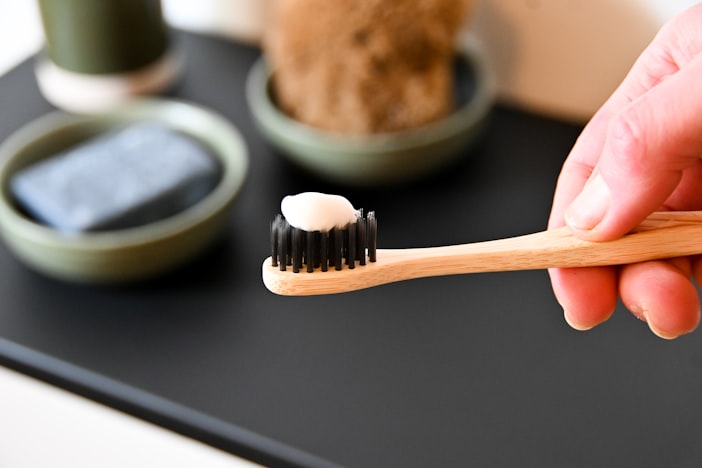
The biggest difference-maker is surprisingly simple: a soft-bristled toothbrush, swapped out every 3 months. The bristles that bend when pressed against the teeth, rather than standing rigid, are the ones protecting gum tissue. Hard and medium bristles are the primary culprits in brushing-related recession.
Technique plays a bigger role than pressure. Gentle, circular motions at the gum line, angled 45 degrees toward the gum, clean effectively without traumatising the tissue. Two minutes of gentle brushing cleans better than 30 seconds of aggressive scrubbing. For people who naturally brush with a heavy hand, electric toothbrushes with pressure sensors have been genuinely transformative: the sensor flags excessive force, and over time, the habit recalibrates.
Regular dental hygiene appointments (every 6-12 months) complete the picture. The hygienist measures recession at each tooth and tracks changes over time, which means progression gets caught early, often before any symptoms appear.
At UrgentCare Dental, the check-up includes gum tissue assessment and, where recession is identified, a conversation about the cause, the stage, and the treatment options. From desensitising treatments to bonding to specialist grafting referrals, the pathway is matched to the severity.
The reassuring truth about gum recession is that while gums don't regrow on their own, treatment can restore the coverage, resolve the sensitivity, and stop the progression entirely. And at the early stages, when a simple change in brushing technique or a £20 fluoride varnish is all it takes, that's genuinely good news.
Common Questions About Fixing Receding Gums
Can a dentist do anything for receding gums?
Yes, and quite a lot, because there's a treatment matched to every stage of recession. For mild cases the answer might be as gentle as a fluoride varnish to calm the sensitivity, or a small tweak to how you brush to stop it going any further. For a root that's on show, composite bonding covers it back over, and for the deeper cases a gum graft rebuilds the tissue that's been lost. The one thing worth knowing is that gums don't grow back by themselves, so the sooner someone takes a look, the simpler the fix tends to be.
Is it expensive to fix receding gums?
It really depends on how far things have gone, and the happy news is that the early stages are the gentle ones on your wallet. Calming the sensitivity with a desensitising varnish sits at around £20, composite bonding over an exposed root runs £150 to £350 per tooth, and a full gum graft is where it climbs, at roughly £400 to £1,200 per area. So catching recession early keeps things kind on your gums and kind on your budget at the same time.
When is it too late for gum grafting?
Honestly, it's rarely ever truly "too late," because even quite advanced recession can be treated. A graft can restore lost coverage as long as the tooth itself is still healthy and firmly in place. It only really becomes off the table if the tooth has lost so much of its supporting bone that it's loose or failing, and at that point the conversation shifts to saving or replacing the tooth instead. The best way to know where you stand is to have someone measure it, because what looks alarming in the mirror is very often perfectly treatable.
Do gums grow back on their own?
They don't, and that's the one honest catch with recession: once gum tissue has pulled away from a tooth, it won't creep back up by itself. That's exactly why treatment matters, because a graft or bonding is what restores the coverage that nature won't. The good part is that stopping the recession from getting any worse is often as simple as swapping to a soft brush and easing off the pressure.
How long does a gum graft last?
A well-healed gum graft is meant to be permanent, because the new tissue knits into your own gum and becomes a lasting part of it. What protects that result over the years is looking after the cause that started the recession in the first place, so gentle brushing and regular hygiene visits keep the graft, and the rest of your gums, settled for the long haul.
Can I pay for treatment monthly?
Yes. Treatments over £500 can be spread across 12 months at 0% APR, and any amount can go on a longer plan (12.9% APR representative), so a bigger piece of work doesn't have to land all in one go. It's worth asking which option fits best when you come in for your assessment.
Need Emergency Dental Care?
Same-day appointments from just £20. Open 24 hours, 7 days a week.
Or see every treatment we offer, with prices →