Dental Health
Dental X-Rays Explained


So you're sitting in the dentist's chair, and they say you need X-rays. And somewhere in the back of your mind there's this little flicker. Radiation. That word. Images of lead aprons and thyroid collars and that heavy protective blanket they drape over you. It all feels very... serious. Very medical. Like there must be something to worry about, or why would they bother with all that?
Here's the thing though: the radiation from a single dental X-ray is less than what you absorb just by existing for a day.
That's not an exaggeration. Background radiation from the sun, the earth beneath your feet, even the food you eat exposes you to around 17 microsieverts daily. A standard dental X-ray delivers somewhere between 1 and 8 microsieverts. You'd get more radiation flying from Manchester to Edinburgh than you would from a set of bitewing X-rays.
In fact, the radiation levels are so remarkably low that current guidance from bodies including the British Institute of Radiology states lead aprons aren't necessary for routine dental X-rays. The exposure is already minimal enough that those extra protective layers don't make a meaningful difference.
So if radiation isn't really a concern, what are dental X-rays actually for? And what do all the different types show?
What Dental X-Rays Actually Reveal
Here's the frustrating truth about teeth: so much of what goes wrong happens beneath the surface. A tooth can look perfectly healthy from the outside while decay quietly spreads in the spaces between teeth, or infection builds at the root. Gum disease can silently eat away at the bone supporting your teeth without any visible sign until things have progressed quite far.
This is exactly why dental X-rays exist. They let dentists see what's happening in the places they physically cannot examine with their eyes or instruments. Cavities forming in those tight spaces between teeth, the health of roots buried deep in bone, wisdom teeth that haven't come through yet, early bone loss from gum disease before it becomes obvious.
Without that view beneath the surface, dentists would be working with incomplete information. Problems that could have been caught early and treated simply would go unnoticed until they became painful, expensive emergencies.
The Different Types of Dental X-Rays
Not all dental X-rays are the same, and if you've ever wondered why you're biting down on a little holder one visit and standing in front of a rotating machine the next, here's what's actually going on.
The ones you've almost certainly had before are bitewings. You bite down on a small holder, the X-ray fires, and it captures your upper and lower back teeth together in one image, which is where the name comes from. These are brilliant for spotting cavities forming between teeth, right in those tight spaces where your toothbrush can't quite reach and decay loves to hide. They also show the bone level between teeth, so early gum disease shows up here too. Most routine dental checkups include a set of bitewings for exactly these reasons.
Now, if you've ever gone in with a toothache and the dentist wanted to see what's happening at the root, that's when they reach for a periapical X-ray. These capture a single tooth from the biting surface all the way down to the tip of the root and the bone surrounding it. When there's an abscess brewing, or when root canal treatment is on the cards, this is the image that shows exactly what's going on down there.
For the bigger picture, there's the panoramic X-ray, which you might hear called an OPG or OPT. This one feels a bit different because you stand still while the machine rotates around your head, capturing your entire mouth in a single sweeping image. All your teeth, both jaws, your sinuses, the joints where your jaw hinges. It's the one dentists use when they want to see how wisdom teeth are positioned, plan orthodontic work, or get an overall sense of what's happening across your whole mouth. Less detail than the close-up types, but you can't beat it for the full picture.
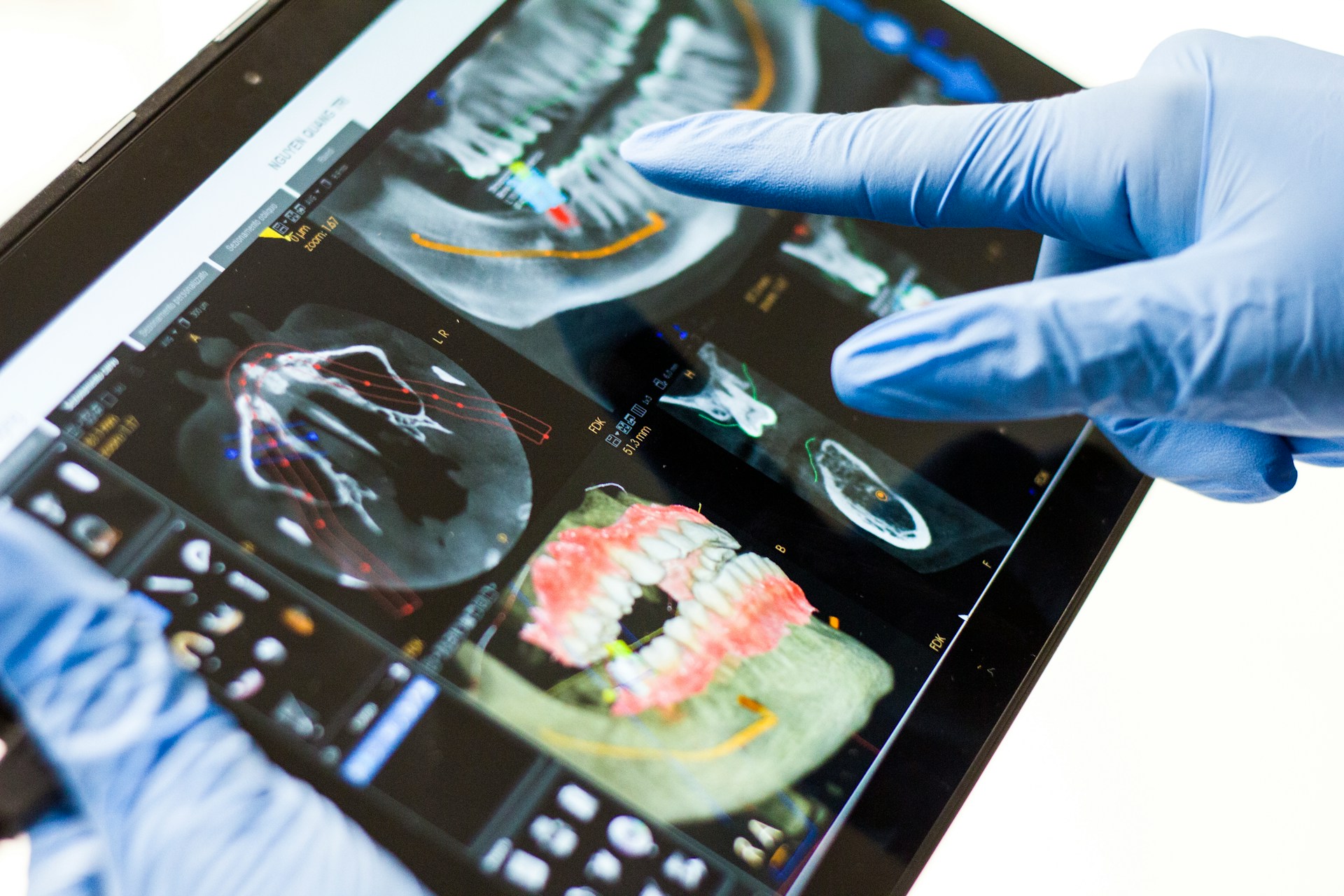
And then there's the most advanced option, the CBCT scan, which stands for Cone Beam Computed Tomography. This one produces proper 3D images of your teeth, jaws, and all the surrounding structures. It does deliver more radiation than standard dental X-rays, typically between 50 and 100 microsieverts depending on the area being scanned, though that's still far less than a medical CT scan. Dentists reach for these when planning something complex like dental implant placement, or when they need to see exactly how a tricky root is shaped before a difficult extraction. At UrgentCare Dental, CBCT scans are £199.
How Often Do You Actually Need Them?
There's no universal schedule here, and that's actually a good thing. How often you need X-rays depends entirely on your own mouth, your history, and what your dentist sees when they examine you.
Someone with a history of frequent cavities might benefit from bitewings every six to twelve months to catch new decay early. Someone with excellent oral health who hasn't had problems in years might go two or three years between routine X-rays without missing anything important. A person being assessed for wisdom tooth removal will need that panoramic image. Someone coming in with unexplained tooth pain will need periapicals of the area that's hurting.
The principle guiding these decisions has a name: ALARA, which stands for "As Low As Reasonably Achievable." It means dentists take X-rays when there's a genuine clinical reason, not on some arbitrary schedule, and they use the minimum exposure needed to get the information they're after.
Digital vs Traditional Film
If you haven't been to the dentist in a while, you might notice things have changed. Most modern practices, including UrgentCare Dental, now use digital X-ray technology rather than the old film-based systems.
This matters more than you might think. Digital sensors need significantly less radiation to produce a clear image, up to 80% less than traditional film required. The images appear instantly on a screen rather than needing chemical development, which means no waiting around and the ability to zoom in, enhance, and adjust for better diagnosis. They can be stored securely, shared easily when needed, and compared over time to track how things are changing.
It's one of those quiet technological improvements that makes a real difference without most people even noticing it happened.
Putting the Radiation in Perspective
It can help to compare dental X-ray radiation to things you're already familiar with. A single digital dental X-ray delivers roughly 0.005 millisieverts. Here's how that stacks up against other everyday exposures.
A chest X-ray delivers about 0.1 millisieverts, which is twenty times higher. A flight from London to New York exposes you to around 0.08 millisieverts from cosmic radiation at altitude. A CT scan of your abdomen delivers between 8 and 10 millisieverts, equivalent to well over a thousand dental X-rays. Even eating a banana exposes you to a tiny amount of radiation from the potassium it contains.
The average person in the UK receives about 2.7 millisieverts of background radiation annually just from natural sources. You'd need hundreds of dental X-rays in a single year to approach that level.
To put it plainly: dental X-rays are among the lowest radiation medical imaging procedures that exist. The benefit of catching problems early vastly outweighs the minimal exposure involved.
What About During Pregnancy?
This is a common concern, and completely understandable. The good news is that dental X-rays, particularly with modern digital technology, are considered safe during pregnancy when they're clinically necessary.
Many dentists prefer to postpone routine X-rays until after pregnancy when possible, simply out of an abundance of caution. But if there's a dental emergency or a situation where X-rays are genuinely needed for diagnosis, they can be taken safely. The radiation dose is extremely low and the beam is directed at your mouth, far from the developing baby.
If you're pregnant and need dental treatment, just let your dentist know. They'll make the right call about whether X-rays are necessary for your specific situation.
X-Rays for Children
Children's mouths are constantly changing. Baby teeth fall out, adult teeth emerge, and quite a lot can go on during those years. X-rays help dentists monitor this development, checking that adult teeth are forming properly underneath, spotting any that might be missing or positioned unusually, and catching cavities in baby teeth before they cause problems.
Children are more sensitive to radiation than adults, which is why dentists are particularly thoughtful about when and how often to take X-rays. Digital technology has been especially helpful here, reducing the already low exposure even further. There are specific guidelines for paediatric imaging that take this increased sensitivity into account.
When X-Rays Are Included Free
At UrgentCare Dental, diagnostic X-rays are included free with any treatment. If you come in with tooth pain and we need X-rays to work out what's going on, those are part of the diagnostic process rather than an extra charge. CBCT scans are £199 when that level of 3D imaging is needed for complex treatment planning.
If you're dealing with dental pain or have concerns about what might be happening beneath the surface, being able to see what's actually going on is often the first step toward sorting it out. Get in touch if you'd like to book an appointment at our Leeds clinic or Manchester location.
Need Emergency Dental Care?
Same-day appointments from just £20. Open 24 hours, 7 days a week.
Or see every treatment we offer, with prices →